iBeta Certification Trends 2024
Complete Industry Analysis
March, 2025
Research by Axon Labs
Introduction to iBeta Certification
iBeta is one of the leading testing labs for biometric systems, providing crucial certifications that ensure a system can accurately differentiate between real users and fraudulent entities. For companies in the e-KYC (electronic Know Your Customer) industry, achieving iBeta certification signals credibility and robust security measures. In the face of increasing presentation attack detection (PAD) threats, certification becomes a key element for anti-fraud biometric solutions. Currently, less than 10% of companies in the e-KYC sector hold iBeta certification, indicating its selectivity and the stringent criteria involved in passing the tests
Overview of iBeta Certification Levels
iBeta offers two levels of certification:
- Level 1: Tests against simpler 2D attacks, such as photos or videos used to impersonate users
- Level 2: More advanced, testing systems’ resilience against sophisticated 3D attacks, including silicone masks
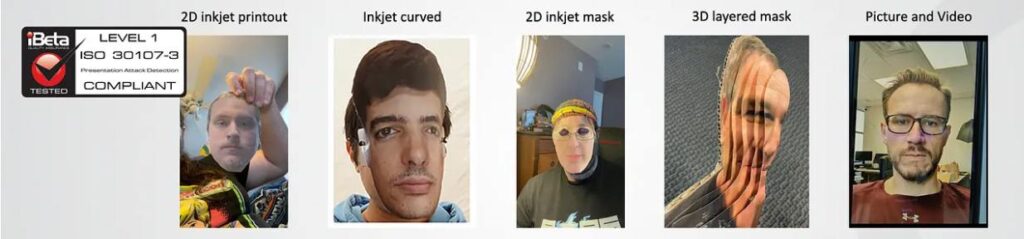
Source: BTG Labs
How many companies are already certified?
Approximately 100 companies operating in the e-KYC market are iBeta certified for both levels over 7 years. This underscores the importance of understanding the iBeta testing process for those seeking regulatory compliance
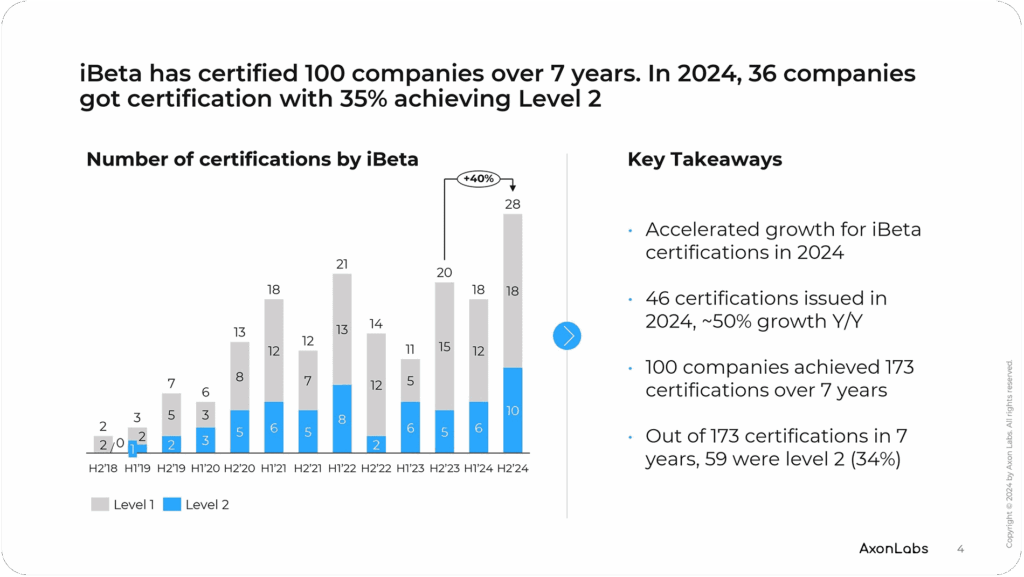
Regional Distribution of Certifications
Asia-Pacific continues to dominate iBeta certifications, accounting for 50% of all issued certificates in 2025. Key market hubs include Vietnam, Singapore, France, Brazil, and the U.S.
Key Companies Leading the Certifications
Asia is a leading region with 50% of certifications in 2024. Other country hubs for e-KYC providers: Vietnam, Singapore, France, Brazil, and the US.
- e-KYC companies: 1Kosmos, Luxand, IDEMIA, Thales Group, Veriff, Suprema, Shufti Pro, Facia, Alchera, WINNING.I, Topaz, Idwall — 50%
- Financial and payment services: Befinancial, Grab, Shopee, Advance Intelligence, GoTo, VIDA Digital, MOMO, VNPAY, Payface, E.SUN — 40%
- Technology and IT companies: Tencent, Verichains, Olimpia IT — 10%
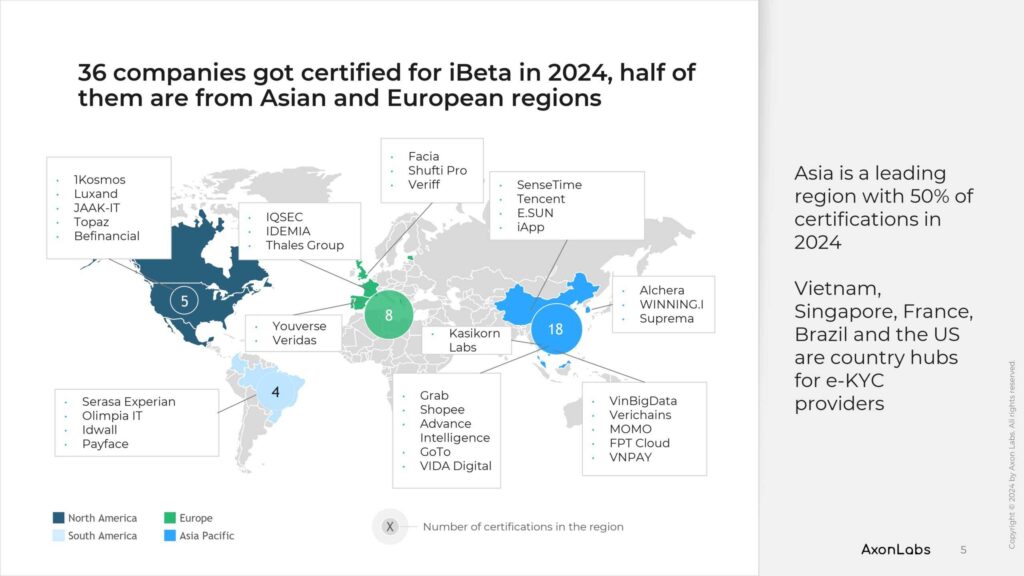
Active vs. Passive Liveness Testing
A notable trend in 2024 is the growing preference for passive liveness detection, which accounts for 55% of all certifications. This method offers a more seamless user experience compared to active detection. This is an important point in passive vs active liveness comparison. Additionally, 65% of the certifications issued this year were for Level 1, which focuses on simpler attack vectors
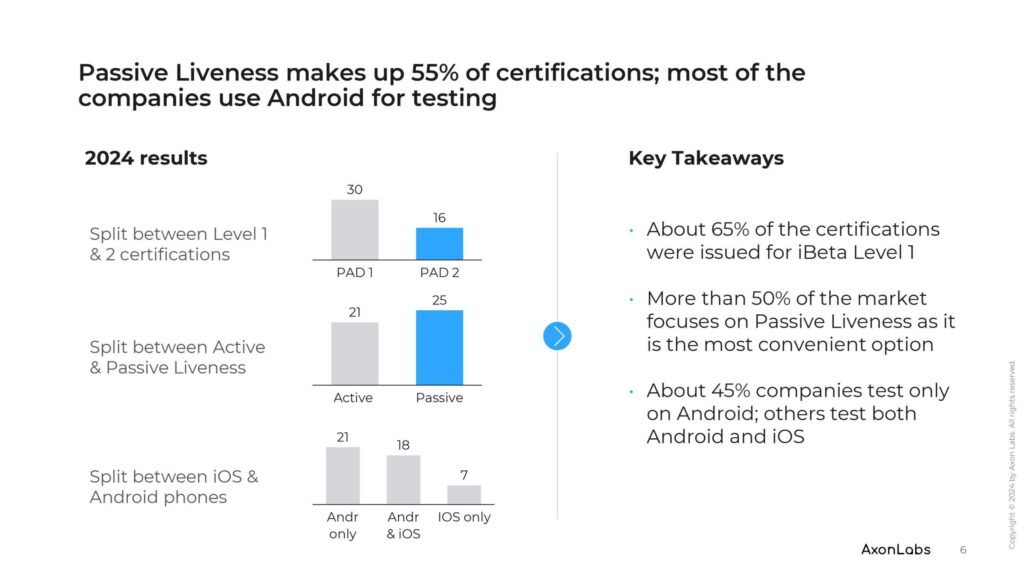
Devices Used for iBeta Testing
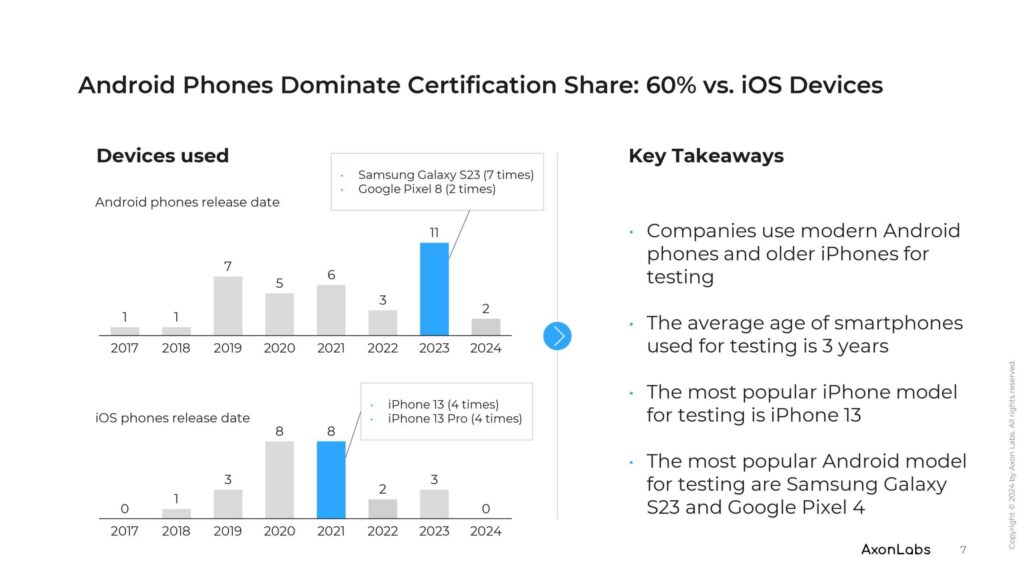
Android devices continue to be the primary choice for biometric testing, representing 60% of all certifications. Companies typically use modern Android phones and slightly older iPhones for evaluation. Mobile biometric testing plays a key role.
The average age of smartphones used in testing was three years, with the most popular devices being:
- Samsung Galaxy S23
- Google Pixel 8
- iPhone 13
About Axon Labs
Axon Labs offers high-quality, ready-to-use data to help your model pass certification on the first try. Our datasets, including small test samples, allow you to validate and refine your model before final testing. Yes, investing in quality data may come at a higher cost, but it will pay off by saving you from repeated attempts and delays. Turn to us, and we’ll provide everything you need to successfully achieve iBeta certification
Success iBeta stories of our clients